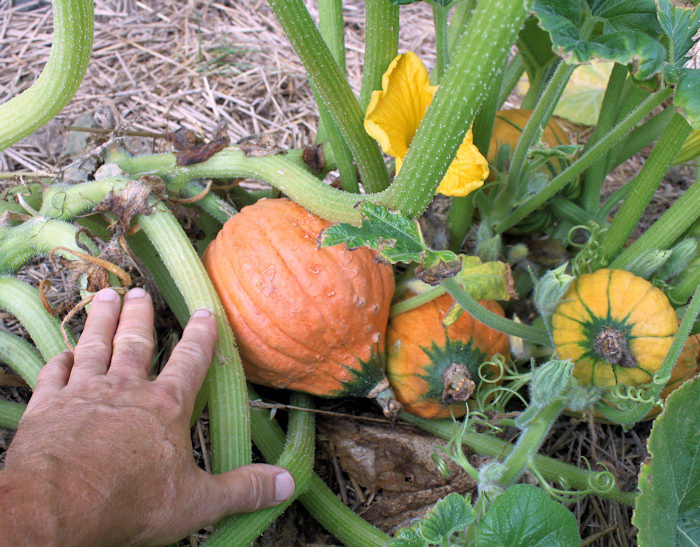
Saturday Spotlight: Gold Nugget Squash

Winter squash is a staple of ours here in the winter months. And Gold Nugget is one of my favorite winter squashes both in the kitchen and in the garden. Like many other flavorful winter squashes, it’s a Cucurbita maxima variety, and was bred here in the U.S. by North Dakota State University to be a sweet potato substitute for short-season areas. This open-pollinated 1966 All America Selection is well adapted to most growing areas though, and it always does well for me here in my zone 6b garden, despite our hot and humid summers. AAS winners can usually be expected to perform well under a wide range of growing conditions.

Gold Nugget squash

Gold Nugget squash

The bushy plants are well-behaved, and stay fairly compact at three to four feet wide. I generally plant ours about three feet apart, and work a big handful of compost into the planting hole along with some all-purpose organic fertilizer. Each plant usually yields four or five squashes for us on average. Squash vine borers are not usually a big problem in our garden, so I can’t say if Gold Nugget has any resistance to them or not.

Gold Nugget winter squash

Gold Nugget winter squash plant

The one to two pound squashes resemble little miniature pumpkins, with a bright reddish orange skin and thick golden flesh inside. Half a squash makes a perfect serving size, and they bake up moist and sweet. We usually season ours with a little butter, cinnamon and honey, but they are also perfect for stuffing with your favorite ingredients. Gold Nugget is a good storage squash too, generally keeping for around six months before starting to lose quality.

Gold Nugget squashes

Gold Nugget squashes from 2013

Gold Nugget squash harvest

Gold Nugget squash harvest from 2010

Seeds for Gold Nugget are available from a number of sources. 2014 listings in the U.S. include Johnny’s Selected Seeds, Territorial Seed, Seeds Of Change, Reimers, Pinetree Garden Seeds and Botanical Interests. It may be called Golden Nugget in some areas, and is also known as an Oriental pumpkin, though its well-documented origins seem to be quite Western.

inside of Gold Nugget

inside of Gold Nugget

If you’re looking for a winter squash for all seasons, I can heartily recommend Gold Nugget. It never fails to please here at Happy Acres. The one in the above photo was baked up a couple of days ago. After almost 7 months in storage it was still sweet and tasty. I hope you have enjoyed this Saturday Spotlight, and I’ll be back soon with more adventures!

To see my other Saturday Spotlights, visit the Variety Spotlights page.

Posted in Saturday Spotlight | Tagged , , , | 4 Comments

Homemade: Whole-Grain Mustard

I guess you could say I’ve been a fan of mustard for a long time. I have always loved all the different styles and variations, and often times the refrigerator had two or three (or more) jars of it at any given time. But a couple of years ago I discovered the joys of homemade mustard. Since then I’ve been making it myself, and now I rarely buy mustard anymore. It’s so simple to do, and economical, that today I want to share how to make your very own whole-grain mustard.

Spicy Whole-Grain Mustard

Spicy Whole-Grain Mustard

By definition, a whole-grain mustard is one where the seeds are visible, with some perhaps left whole. In other words, if it were a peanut butter, it would be the chunky style! A basic mustard needs only two ingredients: mustard seeds and a liquid. The mustard seeds can be yellow, brown or both, and can be whole or ground.

brown and yellow mustard seeds

brown and yellow mustard seeds

Yellow seeds (Brassica hirta or B. alba, aka White Mustard) are the mildest tasting ones and used in many American-style prepared mustards. Brown seeds (B. juncea) are more pungent and are popular in European-style mustards.  There is also a black mustard seed (B. nigra) that is even more potent than the brown seed, and is usually used whole in Indian cooking. You can often find whole mustard seeds in ethnic grocery stores, or in spice shops. Penzeys Spices has them, and if you aren’t lucky enough to have one of their stores in your area you can also order from them online.

wholegrainmustardliquid

The liquid used can be anything from water or vinegar to beer or wine. Water tends to make a hotter finished product, while acidic liquids like vinegar and wine tend to mellow the heat as well as add some flavor. Aging the mustard also help to mellow the flavor. Beyond the basic ingredients, sugar, honey and numerous spices can be also be added to make it your very own one-of-a-kind mustard. And that’s part of the fun of making it yourself – trying out all those variations!

mustard seeds soaking

mustard seeds soaking

I’ve made several different batches of this Whole-Grain Mustard. Today I’ll share two slightly different variations, and hopefully that will give you the basics for coming up with your own version. The first step in both is to soak the seeds in liquid overnight or at least for 8 hours. That softens up the seeds and makes them easier to process.

using food processor to grind the seeds

using food processor to grind the seeds

After soaking, you can use either a food processor or blender to grind up the seeds. I find that the food processor makes for a grainier product, while the blender grinds the seeds to a finer consistency. It all depend on your own preference. You might make one batch each way and decide which way your prefer. I like it both ways! A stick blender also works well for this recipe, and I think it makes for easy cleanup.

Basic Whole-Grain Mustard

Basic Whole-Grain Mustard


The final thing you need to do is age the mustard. Right after processing, it will still be rather harsh and bitter tasting, but aging will mellow it considerably and allow the flavors to meld together. Mustards that are made with whole seeds instead of powder are milder to start with, so age this whole-grain mustard for a few days at room temperature or slightly cooler. If you like your mustard hot, it may be ready in a matter of hours. Taste occasionally, and refrigerate when it has reached the desired level of pungency. Homemade mustard also makes a great gift, so have some fun and experiment with your own mustard creations.

wholegrainmustardcloseup

Basic Whole-Grain MustardPrint This Recipe Print This Recipe

1/4 cup brown mustard seeds
1/4 cup yellow mustard seeds
1/2 cup white wine vinegar
1/2 cup water
1/2 tsp sea salt
additional water or vinegar as needed to thin to desired consistency

Soak mustard seeds in vinegar and water overnight, or at least 8 hours. Be sure and use a non-reactive glass, plastic or stainless steel bowl. After soaking, add any additional ingredients and grind mixture using food processor or blender, adding water and/or vinegar if necessary until desired consistency is reached. Cover and let age for a few days or longer. Refrigerate and use within 6 months.

YIELDS: about 1-1/2 cups

Spicy Whole-Grain MustardPrint This Recipe Print This Recipe

1/4 cup brown mustard seeds
1/2 cup yellow mustard seeds
1/4 cup cider vinegar
3/4 cup water
1/2 tsp sea salt
2 tsp honey
dash of ground cloves
dash of ground allspice
hot paprika or cayenne pepper (to taste)
additional water or vinegar as needed to thin to desired consistency

process same as for Basic Whole-Grain Mustard

YIELDS: about 1-1/2 cups

You might also be interested in these related recipes :

1. Homemade Yellow Mustard
2. Homemade Tomato Ketchup
3. No Rooster Chili Garlic Sauce
4. Basic Fermented Hot Sauce
5. Sriracha-Style Hot Sauce


Posted in Homemade, Recipes | Tagged , | 5 Comments

It’s A No-Harvest Monday, Plus A Tour

The weather warmed up to more normal levels for a couple of days last week, which melted some of our snow cover. It barely thawed the ground out though, which made it slippery to walk on. I took advantage of the sunshine and wandered around with my camera, so I thought I would give a tour of how things look in the garden. I have to say I have lowered my expectations as to what might be growing, given the amount of cold weather, snow and ice we have had this winter.

First up is a peek under the cold frame cover where spinach is planted. The cold frame cover still has snow and ice on it, and is quite heavy. I lifted it just enough to get a quick look and a photo.

spinach plants in cold frame bed

spinach plants in cold frame bed

I think the spinach is looking pretty good, along with some henbit and chickweed. Spinach is so hardy that it almost always overwinters here when protected by a cold frame or row covers. I did start a few seedlings in case I need to fill in the beds a bit. I always like to have a backup plan! Next up is the greenhouse. I couldn’t get the door open fully because of ice on the ground, but I was able to open the top half and look inside. Things in there are on autopilot until the ice is gone. In the below photo I see some chard in the back that is still green, and some lettuce plants in front that look pretty ragged.

greenhouse bed with chard and lettuce

greenhouse bed with chard and lettuce

I think I will just replant the lettuce when I have seedlings ready, but the chard might give us a taste or two before it bolts to flower. The chard was an experiment to see how it did in the winter greenhouse environment. I wish now I had planted some kale in there too, but I didn’t. I have started some kale for a spring planting. I sure miss not having fresh kale. On the other side of the greenhouse, I see dead lettuce and a nice patch of green spinach. Not showing in the below photo are 4 parsley plants that still have edible leaves. It should keep producing too until it decides to flower come spring. Chickweed seems to be thriving as well. Perhaps our next salad might feature it! Hopefully when I can get the door open I can do some weeding and cleanup in the greenhouse.

greenhouse bed with spinach

greenhouse bed with spinach

The bare ground inside the greenhouse is deceptive. Most everywhere outside the snow is still hanging on. And it’s covered with animal tracks, including ones I recognize like raccoon, dog, cat and deer, plus a few I don’t. This winter has surely been hard on the local deer. They are not finding much to eat under these conditions.

deer track in kitchen garden

deer track in kitchen garden

Most of the main garden area is still snow covered too. There’s broccoli in the front of the bed in the below photo, and I’m sure it is frozen out. The kale plants behind it are still standing up, but I have no idea if they are alive. I would be surprised if they make it, but we will see. At least there are no deer tracks inside the fenced in garden. The garlic bed is well covered in snow, which should help keep it insulated. At least I hope so. The weather is due to warm up later this week, and the snow should all be gone. Then I should be able to get a better idea of how the kale is doing.

kale plants in snow

kale plants in snow

Inside the house, we have been enjoying food from the freezer and pantry. My wife took some of the frozen spinach from the freezer and made a spinach pie last week. I need to share that recipe, even though I have never made it myself and technically it is her recipe. Perhaps she will post it herself sometime (hint, hint). This batch had ricotta and mozzarella cheeses plus mushrooms and horseradish. It is a great way to use our homegrown frozen spinach.

Spinach Pie made from frozen spinach

Spinach Pie made from frozen spinach

Yesterday I used some of our Trail of Tears beans to make a batch of bean soup. I had just enough left from last year to make a nice pot of soup. I wish I had room to grow more dry beans, but I am thankful I was able to get a nice harvest of them last year.

Trail of Tears beans after soaking

Trail of Tears beans after soaking

I soaked the beans all day, then cooked them in the pressure cooker along with onions, celery, carrots and red bell pepper. Some of our garlic and a little homemade chile powder also went into the mix. These lovely black beans hold their shape well, even in the pressure cooker, and have a great flavor. I’ll be growing them again for sure.

Trail of Tears bean soup

Trail of Tears bean soup

I also used up some of our frozen grated zucchini to make a batch of Spelt Chocolate Zucchini Muffins. We have been eating these so often we are running low on frozen squash. I guess this year I will have to freeze even more squash than usual so we don’t run out. I grated a bit of dark chocolate on top of the muffin dough before baking. It was left over from making lip balm and I wanted to put it to good use before I ate it all!

grating chocolate on zucchini muffin batter

grating chocolate on zucchini muffin batter

And speaking of muffins, yesterday I baked a batch of Blueberry-Coconut-Macadamia Muffins. I used frozen blueberries from our bumper 2013 crop, plus some macadamia nuts we got at a farmer’s market in Hawaii. Mac nuts there are relatively inexpensive ($10/lb) so we usually bring some home for use later.

blueberry muffin batter

blueberry muffin batter

I think these are my favorite blueberry muffins. The sweet streusel topping goes well with the tart and juicy blueberries inside. Of course, the coconut and macadamia nuts kick it up a notch or two!

Blueberry-Coconut_Macadamia Muffin

Blueberry-Coconut_Macadamia Muffin

I hope you enjoyed a tour of the frozen gardens here in February, and a look at what we are doing with some of our 2013 harvests. To see what others are harvesting or cooking up, visit Daphne’s Dandelions where Daphne hosts the Harvest Monday series.

 

Posted in Food, Gardening, Greenhouse | Tagged , , , , , , , , , , | 8 Comments

Homemade: Chocolate Lip Balm

There are some things you do because you have to. Work comes to mind, along with taking out the trash. And then there are some things you do because you think you ought to. You know, things like brushing your teeth, and eating more broccoli. This project is not like any of those things. This project is one to do just for fun. And maybe for someone you love. Or at least someone who loves chocolate!

Chocolate Lip Balm

Chocolate Lip Balm

This is an amazingly easy to make chocolatey lip balm. It was inspired by this recipe at the Soap Queen blog. I tweaked it a bit to use only 3 ingredients I had on hand. Sometimes simpler is better, I think. You may need to adjust the final product a bit depending on the ingredients you use, and your personal preference.

ingredients for Chocolate Lip Balm

ingredients for Chocolate Lip Balm

Since it’s a fairly small amount of stuff, I included the weight of the ingredients in grams. In general terms, it is 3 parts chocolate to 2 parts each of beeswax and coconut oil.

weighing the ingredients

weighing the ingredients

You melt the chocolate, beeswax and coconut oil in a double boiler setup on the stove top. I used a small glass Pyrex measuring cup, set in a pan of gently boiling water. I also used a bamboo skewer for a stirrer.

melting the lip balm

melting the lip balm

To test the firmness of the lip balm, put a butter knife in the freezer for a few minutes. Then you can stick it in the melted mix and withdraw it. The lip balm will solidify quickly on the cold knife, and you can test the consistency that way. If it’s too stiff, add more chocolate and/or coconut oil. If too soft, add more wax.

testing the consistency

testing the consistency

The chocolate you choose makes a big difference in the finished product. You want to use something with a high percentage of cacao in it. I used a 70% bittersweet for one batch, and a semi-sweet chocolate bar for another. Neither one had any milk solids in them, which do not work well in this recipe. It doesn’t have to be expensive chocolate either. I made one great batch using semi-sweet baking squares. You could easily make a vegan version of this by substituting candelilla wax for the beeswax. You will need to adjust the recipe, and use less of the candelilla than you do beeswax. I also used a nice organic, extra virgin coconut oil which adds a bit of flavor.

pouring lip balm into tube

pouring lip balm into tube

Our well-stocked craft closet had twist-up lip balm tubes and nice little metal tins just waiting for me to use. If you don’t happen to have any on hand, any clean, small container with a lid will do. You can easily size the recipe to fit the container(s). Pour while warm and then let cool thoroughly before using.

I hope you have enjoyed reading about this little adventure as much as I have enjoyed making this yummy lip balm. And I want to give special thanks to my wife, who helped me setup the photo shoot, and lent her artistic eye to the proceedings. Shhhh, don’t tell her she is getting the lip balm for Valentine’s Day!

Chocolate Lip Balm Print This Recipe Print This Recipe
Adapted from a recipe at Soap Queen blog

Beeswax – 4 grams (29%)
Bittersweet Chocolate – 6 grams (42%)
Extra-Virgin Coconut Oil – 4 grams (29%)

Weigh all ingredients in small glass measuring cup. Melt by sitting measuring cup in pan of gently boiling water. Stir until all ingredients are melted, then pour into containers.

Let cool thoroughly before using.

UPDATE: For a real taste treat, try making this lip balm using Coffee Infused Oil.


Posted in Crafts, Homemade | Tagged , , , , | 3 Comments

Monday Recap: Icy Edition

I thought I would start the week by doing an update on recent projects I’ve been working on. And let me say that while we were fortunate to escape much of the snow that blanketed the U.S. last week, we did get some ice. The event was unusual in that we got snow first, then sleet and freezing rain. Normally the progression we get is from freezing rain to snow. Either way it makes for slick conditions, but it was pretty to look at.

ice-covered tree branch

ice-covered tree branch

With temperatures staying below freezing, the ice remained on things for several days. It was especially pretty and bright when the sun was shining.

ice-covered dogwood tree

icy dogwood tree

So what do you do when you are snowed/iced in? How about making some soap! My wife and I made two batches last week, while continuing our testing of using natural materials to color them. One soap used madder root infused olive oil, while the other used alkanet root infused oil. Madder root is used to dye things in pink to red shades, while alkanet dyes them in blueish/purple shades, depending on the pH. The below photo was taken right after pouring the soap into the PVC molds.

madder root(L) and alkanet (R) colored soaps

madder root(L) and alkanet (R) colored soaps

The colors lightened up a bit after the first 24 hours of curing. We’ll let it sit for a few days to harden up before cutting. We’re pretty pleased with how the colors turned out, and I look forward to more experiments using natural soap colorants.

uncut logs of alkanet(L) and madder root(R) colored soaps

uncut logs of alkanet(L) and madder root(R) colored soaps

Another interesting project I had last week was a photography session. Recently my wife was asked to show some of her fabric dyeing art at the University of Evansville. She decided to invite her friend and fellow artist Evi Slaby to exhibit along with her. They needed a couple of photos to send to the UofE, and I volunteered to help.

Lynda with Evi Slaby

Lynda with Evi Slaby

Photographing two lovely ladies proved to be much easier than getting a good image of their art. We finally settled on a black cloth background, set up on the living room floor. Titled “Colorful Friendship: A Study in Fabric Surface Design”, their display at the Krannert Gallery on the campus of the University of Evansville will run from February 24th through April 1st. From what I’ve seen so far, it promises to be a real knockout.

a sample of pieces for the exhibit

a sample of pieces for the exhibit

I also found time to start some seeds while the snow and ice was coming down outside. Even though the outside temperature is 6°F as I write, and it is only 19°F in the greenhouse, it will be time to set out some early spring greens in a few weeks. At least I hope it will be warm enough! I started seeds for parsley, spinach, arugula, lettuce and kale. That’s spinach coming up in the below photo.

newly germinated spinach seedling

newly germinated spinach seedling

Speaking of seeds, I’ve ordered most of my seeds for 2014, and they are here and have been put up with the rest of my seed stash. I’m still working on my exact schedule, but you can visit my Seed Starting and Planting Schedule page to see my general guidelines on starting seeds for our area. If you are new to starting plants from seed, or have questions about the process, you can visit my Seed Starting 101 page for more information.

I’ve also been working lately on improving my photography skills. I just read Food Photography For Bloggers by Matt Armendariz, and it is chock full of great ideas. I would certainly recommend it for anyone who wants to make their online food photos look better. One thing I did after reading the book was buy a Lowel Ego tabletop fluorescent light unit. I’m still experimenting with it, but the results so far have been dramatic. I used it last week to capture the images for Patchouli Citrus Hand Soap. The below photo shows the setup I used to get this image of the soap bars. As you can see, I didn’t even have to clean off the kitchen counter for this one.

setup for photo using Lowel Ego light unit

setup for photo using Lowel Ego light unit

The light unit is set up to the left, while the bounce reflector card (included with the Lowel Ego unit) is set to the right to ‘bounce’ light back into the soap to help fill in the shadows. I struggle with lighting in our kitchen all the time, and this should help tremendously. I also used a tripod for the soap photos to make for sharper images. That definitely helped for the closeup  photo of the pumice and orange peel powders, which used a macro lens to get up-close and personal. One teaspoon of pumice powder looks like a mountain using the macro lens.

teaspoon of pumice powder

teaspoon of pumice powder

I’ve also been enjoying some late-blooming Christmas cacti. This one in the below photo is a new one with peach colored blooms called Christmas Fantasy. It is adding a little color to this cold and mostly colorless time of year.

‘Christmas Fantasy’ Schlumbergera

My next project involves chocolate and the rapidly approaching Valentines Day. That meant I had to buy a couple of bars of chocolate. Of course I had to taste them before I used them. I believe they will be okay for my project, but I might need to do some more taste-testing first. I probably should not be left alone with chocolate in the house!

bittersweet chocolate after testing

bittersweet chocolate after testing

I hope you have enjoyed this recap of things that are going on here. I’ll be back later this week with a recipe for something sweet for Valentines Day!


Posted in Food, Gardening, Photography, Soap | Tagged , , , , , , , , | 9 Comments