Butterfly Banquet Part 1

The butterflies are having a grand time here this summer. The Butterfly Garden has been positively alive with them lately. I could spend all day out there, if it weren’t for getting sunstroke! I’m trying to learn which plants are most loved, and there have been a few surprises.

The Tithonia is a real favorite of the swallowtails. I counted 8 at one time the other day, though it’s really quite hard to count them. About the time I make the rounds visually someone has moved away, or flown in, and I have to start the count all over. It’s a moving target.

Swallowtail on Tithonia

I believe the black ones are a black form of female Tiger Swallowtails, though I confess I am not as good with identifying butterflies as I am plants.

Whichever kind of swallowtail these are, they also enjoy the zinnias. These State Fair zinnia flowers are big, but so is the butterfly.

The yellow male Tiger Swallowtails like the Tithonia and Zinnia also.

The Painted Lady is another common butterfly that loves both of these annual flowers.

Painted Lady on zinnia

Painted Lady on Tithonia

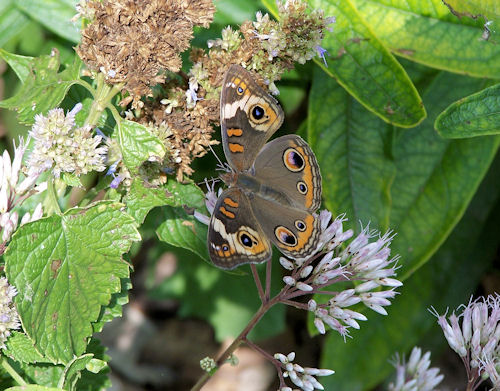
I have several varieties of Agastache planted in this garden, but the Blue Fortune variety is a favorite of the Buckeye butterflies. There’s something about the flowers on this one that really attracts them to it. The other Agastaches aren’t nearly so popular.

Buckeye butterfly on Agastache

There are usually several Buckeyes on this Agastache at any one time. I caught two together in the photo below.

The Buckeyes also like to hang out on the Joe Pye Weed.
This is getting a bit long, so I’ll be back tomorrow with some more photos of the ongoing Butterfly Banquet, including a shot of our Mystery Guest.

Posted in Gardening, Nature | Tagged , , | 8 Comments

We’re Cookin’ Here!

Things are cooking here at Happy Acres, both literally and figuratively. We are in the grips of another heat wave, with temps hitting 100F yesterday and heading for 102 today. And even though it’s been a hot, dry summer, the garden here is still producing great for us, with over 620 pounds harvested so far in 2010. Our freezer is getting full, which is not a bad thing! And the church garden has been supplying several local agencies with lots of fresh veggies.

These days I’m doing well just to keep up with the garden(s), with little time left to blog about them. We’ve gotten over 100 pounds of tomatoes alone, and those that weren’t eaten outright have been dried, sauced, oven roasted and grilled. I’ve got a pan of them slow-roasting in the oven at this very moment. Some of those will go on pita pizzas for lunch.

tomatoes roasting in oven

The small-fruited varieties like Juliet, Golden Rave, Sapho, Jenny, Flamme, and Black Cherry are great dried but recently we’ve been enjoying them when they’re roasted in a slow (225F) oven for 2-3 hours, until they are shriveled up and the flavor is concentrated. I drizzle a little olive oil over them first and they are yummy!

just-layered compost pile

Another thing we’ve got cooking is the compost pile. Last week I turned/forked over bin #1 into bin #2, sifting out 6 bushels (48 gallons) of finished compost in the process. That will be put to good use around the gardens. I also shredded some brown material that had been accumulating in a pile, plus the 30 or so broccoli stalks from the spring planting, and several wheel barrow loads of trimmings from the giant Rose of Sharon bushes. Bin #2 is now layered in a nice mix of green and brown materials and is merrily cooking away.

I’m too frugal (aka cheap) to buy a compost thermometer, so I stuck an old meat thermometer down in the pile as far as it would go. It’s hitting almost 150F a few days after finishing the pile, so it’s off to a great start. The chipper/shredder has been a great investment for us, and we are now able to use 99% of our yard waste. We still bag a few nasty things like poison ivy and bermuda grass, but everything else gets turned into either compost or mulch.

Butterfly Garden in August

The Butterfly Garden (aka Wild Garden) is also really cooking now, in a good way. It’s about at its peak, with Tithonia, Zinnia, Salvia, Cosmos, Joe Pye Weed, and Sunflowers coming on just as the coneflowers and daisies are fading. This area is visited by a large number of butterflies and pollinators every day. The Lemon Queen sunflowers are towering over the rest of the plants. They are every bit of 10 feet tall, with many lemon yellow sunflowers now open.

Lemon Queen sunflowers

I’m growing the Lemon Queen sunflower variety in order to participate in the Great Sunflower Project. I recently finished the first counting of bees, and I’m happy to report we had a lot of visitors in a 15 minute period. The data collected will help researchers learn about the state of bees all over the US and Canada. I figure our bees need all the help they can get, since we’d be lost without them!

That’s a little taste of what’s cookin’ at Happy Acres in early August.

Posted in Gardening | Tagged , , , , , , , | 5 Comments

Freezer Tomato Sauce

For many gardeners summer means homegrown, backyard tomatoes. This tomato sauce is a great way to preserve the bounty and goodness of tomatoes, homegrown or otherwise.

It’s not highly seasoned, so the tomato taste can really shine. It can be used in any dish calling for canned tomato sauce, which makes it very versatile in the kitchen.

This sauce is best made with paste tomatoes like Roma. If slicing tomatoes are used, the yield will be less as they have more liquid and less solids, but the taste will be fine. You can also compensate by using more of the non-paste type tomatoes.

Freezer Tomato  Sauce Print This Recipe Print This Recipe
Adapted from a Better Homes & Gardens recipe

The original recipe says this keeps for 6 months in the freezer, but if kept at 0°F or colder it should keep for several months longer without a noticeable decline in quality.

10 cups paste tomatoes (about 6 pounds)
1 cup onions, chopped
1/2 cup celery, chopped
3 cloves garlic, minced
1 tbsp olive oil
1 tsp sugar
1 tsp salt(optional)

1. In a large kettle, add 4″ water (enough to cover tomatoes) and heat to boiling. Add tomatoes to boiling water in small batches, leave in water for 1 minute (this makes them easier to peel) . Drain in colander; peel, core, seed and chop tomatoes.
2. In the same kettle, heat oil and saute onions and celery for about 5 minutes, until soft but not browned. Add garlic and cook for another minute.
3. Add tomatoes, sugar, and salt. Simmer, uncovered, for one hour, stirring occasionally.
4. Place kettle in sink and immerse in cold water to cool tomato mixture.
5. Process sauce in food processor bowl in small batches, to desired consistency. Sauce may also be put through a food mill.
6. Fill freezer containers; seal, label and freeze.
7. Makes about 4 pints/8 cups.

Servings: 8

Nutrition Facts
Nutrition (per serving): 69 calories, 19 calories from fat, 2.2g total fat, 0mg cholesterol, 308.8mg sodium, 586.2mg potassium, 12g carbohydrates, 3.1g fiber, 7.5g sugar, 2.3g protein, 32.1mg calcium, <1g saturated fat.


Posted in Recipes | Tagged | 8 Comments

Small (But Mighty) Wonder

I’m guessing spaghetti squash is an oddity for most people, something they see at the grocery store and wonder how it can be cooked and eaten. And even in the garden it is somewhat of an oddity that many gardeners are not familiar with. That’s a shame, because I have found them easy to grow, if somewhat rambling. There are bush varieties available (Tivoli is one), though most varieties have long vines and require a fair amount of space.

Botanically it is a winter squash (Cucurbita pepo).  But in the kitchen I think it tastes more like a summer squash. And nutritionally they are more like summer squash, being more watery and less starchy than say a butternut or acorn squash. But then they also have a hard rind and keep much like a winter squash. Confused yet? It’s no wonder they get little respect – they have an identity crisis!

Spaghetti squash gets its name because of its stringy flesh, which can be separated after cooking into long strands that resemble spaghetti pasta. Many people like to use it as a pasta substitute, since it is much lower in calories. One cup of plain cooked spaghetti squash has around 40 calories, with 2 grams of fiber, 1g of protein, and negligible fat. Compare that with the 200 calories found in one cup of cooked spaghetti pasta and you can see why the squash is a dieter’s delight.

Most of the varieties of spaghetti squash, and the ones I usually see in the grocery, are quite large and often weigh in at 3-4 pounds. But a few years ago I tried a variety called Small Wonder that promised smaller, 1-1/2 to 2 pound squashes, and I’ve been growing it ever since. The smaller size suits our household much better than the larger ones. The name is misleading however. While the squashes themselves might be smaller than the standard type, there are LOTS OF THEM! And in my garden, the vines meander all over the place.

I planted 2 seedlings in one “hill” in early May, and about 2 months later I had the first ripe squash. Since I started the seeds indoors, I got about a 3 week jump on the usual 75-80 day maturity of this variety. And this year I planted them on the edge of the garden, where they could vine up the deer fencing if they liked. At least that was my plan. The squash had a plan of their own however!

I’ve been finding the squash all over the place. The one below is over by the caged tomatoes, 15 feet away from the start of the vine.

This pair was hanging out two rows over, with the summer squash. I told you they had an identity crisis!

This one escaped the boundaries of the garden and is growing in the no-mans-land between the plastic deer fencing and the metal fencing that keeps out rabbits and other gnawing pests.

This green one escaped also.

And the vines aren’t through producing yet. Here’s a female blossom that will open in a day or two.

Ack! Here’s another potential spaghetti squash. They’re taking over! At least this vine got the memo about climbing on the fencing.

The 15 squash in the photo below weighed around 24 pounds, with an average weight of 1.6 pounds. The smallest weighed just over 1 pound and the largest was 2.1 pounds. There are at least 6 more out in the garden that aren’t quite ready to pick yet. They could add another 10 pounds or so to the total yield.

That’s a pretty good deal from a packet of seeds that cost $2.45 in 2008 and has given us three years of wonderful spaghetti squash!

There are a lot of good recipes around for these squash, but we usually do a fairly simple treatment when serving them. One way we like to cook them is to cut the squash in half, scoop out the seeds, then add a little water and bake cut side down, covered, in a baking dish for about 50-60 minutes at 375F. When tender I add a little butter, honey and minced ginger, and return it to the oven for 5-10 minutes. Then I fluff up the strands with a fork, scoop out the flesh and serve.

baked spaghetti squash

It’s also nice cooked plain then tossed with a little pesto sauce. The squash can also be microwaved, baked, or boiled. However you cook them, spaghetti squash are an interesting and tasty addition to your kitchen repertoire. Give them a try sometime, or better yet, try growing them in your garden.
Posted in Gardening | Tagged | 21 Comments

Time To Get Pickled

This past week I found time to tackle several pickling projects. For one thing, I have been wanting to make pickled garlic ever since I read Lynn’s post about it on her blog. I am looking for ways to preserve our garlic, and to be able to enjoy it for a longer period of time. Last year’s harvest was all shriveled up by late March, which left us with (sob) several months of NO GARLIC! Pickling is one way to make the garlic last longer.

pickled garlic

I am also going to try freezing some whole cloves of garlic and see how that works. I know the texture will change, but hopefully the flavor will still be there after thawing out.

Back on the pickling front, I also had some pepperoncini peppers ready to pickle. We don’t eat a lot of these peppers, so I only planted one plant. But even with one plant, there are usually a lot of peppers, so I like to pickle some of them. I didn’t process these in a boiling water bath, since they will stay in the refrigerator and be eaten within a month or so. For them I used a recipe for pickled peppers from my Ball Blue Book. For whole peppers like this I always cut a slit in them to allow the pickling solution to get inside the pepper, and to keep them from floating. This variety of pepperoncini is larger than what you usually see pickled at the grocery store.

And when cucumbers are available fresh from the garden like they are now we always have a batch of refrigerator pickles to munch on. I made these with rice wine vinegar, sugar, canola oil and a little salt.

After the pickles are made comes the hardest part for me – waiting until they are ready to taste! I won’t open the garlic for several months, but the pepperoncinis will be ready in about a week. And by the time you read this, those cucumber pickles may already be history!

Posted in Gardening, Recipes | Tagged , , , | 16 Comments