
Coffee Infused Oil

I’m taking a break from gardening and cooking today to talk about something completely different: infusing coffee in oil. Before I get into the how-to part, the first thing you might be wondering is ‘why on earth is he doing this and what is he going to do with it?’ I’ll get to that in a minute. While infused oils are popular in the kitchen, flavored with things like garlic and herbs, many people are unfamiliar with their use in other ways. And this coffee oil is not destined for eating or cooking, though it is possible some of it will wind up on my body!

coffee infused olive oil

coffee infused olive oil (click on any image to enlarge)

For background, my wife and I have been making soaps, lotions, balms and other personal care products for several years now. And occasionally, coffee has a starring role in them. For Christmas in 2011, she made some awesome coffee flavored lip balm to give away as homemade presents. Of course we used it too. And recently she made some coffee hand cream, which I absolutely love. With all that coffee action going on, I had the bright idea to try and make a coffee bath soap, plus some more coffee lip balm. So a coffee infused oil seemed like a good thing to make for both projects.

this coffee lip balm is past its prime

this coffee lip balm is past its prime

I chose olive oil this time, but any carrier oil can be infused. Other popular choices include almond, coconut, and jojoba oils. And all kinds of herbs and flowers can be infused too. My wife is currently making separate infusions of calendula flowers, nettle leaves, and plantain. For her infusions she is using either almond oil or coconut oil. I picked olive oil because it is a major ingredient in all of our soap recipes, and it is a good choice for lip balms as well. Olive oil is one ingredient that is great for your body both on the inside and outside. But then, so is coconut oil for that matter, and I love it for lip balms.

UPDATE: Check out my recipe for Coffee Lip Balm. This oil is also great in my Chocolate Lip Balm.

cold infusing calendula

cold infusing calendula

To infuse the coffee in oil, you can use either one of two methods. If you have plenty of time, you can use the cold infusion method by adding the coffee and oil to a clear glass jar and letting it sit for a few weeks (up to a month). I’m anxious to get my projects done sooner than that, so I chose the hot infusion method. I used equal parts of medium grind French Roast coffee and a good quality, mild-flavored olive oil. I put the coffee and olive oil in a small crockpot and turned it on low for about 8 hours, stirring occasionally. After that, I turned it off and let it sit until it was cool.

infusing coffee oil in crock pot

infusing coffee oil in crock pot

The cold infusion method is generally recommended for leafy herbs and flowers, though I haven’t found any science to back that. So that was a good choice for my wife’s infusions, where she is looking for the healing properties of calendula flowers and the anti-itch action of plantain and nettle leaves. I’m mainly interested in the aroma, color and flavor of the coffee in the oil, though it is supposed to be good for your skin as well. And besides, coffee grounds are pretty tough, and brewing with hot water is the usual method of ‘infusing’ them before they wind up in a coffee cup!

coffee infusing in oil

coffee infusing in oil

After infusing with either method, the coffee grounds need to be strained out from the oil. I placed a coffee filter into a fine mesh strainer set over a glass measuring cup, and carefully poured the oil in. It took several hours to drip through the filter and strainer, but the result was an infused oil that was free of any bits of coffee. You can use old, clean nylon stockings to strain the oil from an herb or flower infusion, and that process will go much quicker, though the oil may still have some coffee residue.
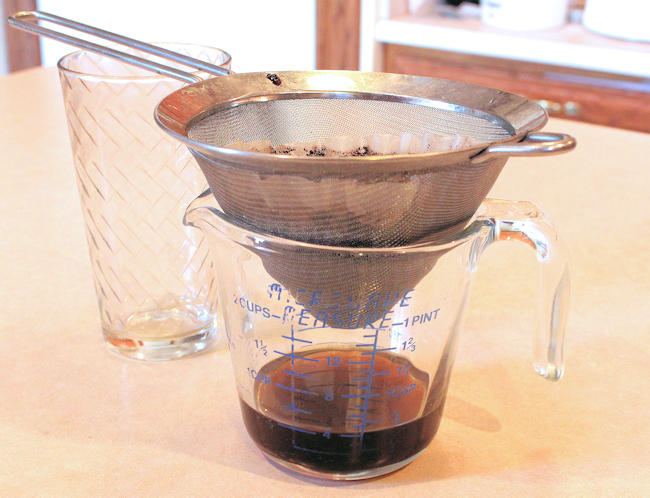
straining the oil after infusing

straining the oil after infusing

After straining out the grounds, they went into the compost pail where they will ultimately wind up enriching the garden. The oil is a dark brown, almost black color and the aroma is like a cup of fresh-brewed coffee. I am very pleased with how it turned out. Quite a bit of the oil was absorbed by the coffee and the filter (about half of it) so be sure and start with about twice more oil than you need for your project.

closeup of finished coffee oil

closeup of finished coffee oil

The shelf life on these non-edible infused oils is about the same as the shelf life of the plain oil. In my case, olive oil has a shelf life of about a year, if kept in cool dark place. For coconut oil, you should be able to go by the expiration date on the label of the oil you use.

coffee infused olive oil

coffee infused olive oil

I want to emphasize the need to use high-quality ingredients for this coffee infused oil. Be sure and use a coffee you would drink, not some cheap brand. And the same goes for the oil. I use extra-virgin and organic coconut and olive oils for all my homemade skin care products, and an expelled-pressed food grade sweet almond oil.

solidified coffee infused coconut oil

solidified coffee infused coconut oil

UPDATE: Since I first wrote this, I have done several more batches of coffee infused oil. My current favorite for lip balm is a medium roast coffee infused for about two hours in extra-virgin coconut oil. For a coffee skin salve, I use either almond or olive oil, and for soap I use olive oil. The coffee infused oil can be used to color soap, but the aroma is lost during the saponification process. Check out our Mocha Java Hand Soap to see how the infused oil colors the soap.

Posted in Homemade | Tagged , , , | 78 Comments

Seed Starting 102 – Homemade Mini Greenhouses

Even though for the most part starting plants from seeds is fairly easy, sometimes the seeds need a little extra pampering to get them up and growing. For example, some seeds are tiny, others might have a long germination time, or maybe the seeds themselves might be older and in need of some extra TLC. My strategy for that is to use homemade mini greenhouses, as I like to call them. It’s an easy way to increase your chances of success with problematical seeds.

homemade mini greenhouse containers

homemade mini greenhouse containers

You can buy ready-made flats and containers that come with a plastic dome or lid, but I’ve had good luck making my own version. It’s less expensive that way, and if you grow plants from seed you are likely to have all the necessary ingredients you need already on hand. And of course I’m a sucker for DIY projects, especially when they save me money.

fill soil to within 1 inch of top

fill soil to within 1 inch of top

You can use any clean container you might have, and add your favorite seed starting soil (or soilless) mix. Fill the soil to within about an inch of the top. This leaves a little headroom for the plants after they come up. For seeds that need warm conditions to germinate, I put the containers on a heating mat that supplies bottom heat.

tomato seeds sown in coco coir

tomato seeds sown in coco coir

Sow your seeds and then cover to the proper depth, or leave on the surface of the soil if they need light to germinate. I often use a moistened toothpick to transfer the seeds to the soil, and it does a great job. To finish, cover the container with some clear plastic wrap and secure it with a rubber band. Give them a drink of water, and that’s all there is to it. The plastic can be removed when the seeds sprout. A cover should never be left on plants receiving direct sunlight after they have sprouted, or else the cover will act like an oven and cook the little plants!

toothpick makes good tool for transferring seeds

toothpick makes good tool for transferring seeds

I typically use a 3-1/2 inch square plastic pot for this operation, since I usually have them on hand, and they are big enough for most of my needs. Last month I started petunia seeds this way. Petunia seeds are tiny, need light and warmth, and can take a couple of weeks to germinate. They’re also pricey, and I don’t want to waste a single one of them! Those seedlings are now about ready to be transplanted into larger containers.

these petunia seedlings are ready to be transplanted

Purple Wave petunia seedlings are ready to be transplanted

This week I started a few pepper and tomato seeds that needed some TLC treatment. My 2009 Happy Yummy Pepper seeds are losing their viability, that is if they have any left at all. These are seeds I saved from the original ‘rogue’ hot peppers, and tend to produce mostly hot pepper plants with a few sweet ones thrown in. We will see if I can get some of them to germinate. I also put some of the 2011 and 2012 saved seeds in containers too. For these pots I used 100% coco coir as the starting medium. In my experiments so far I like the way this material is performing for me, and I have had zero problems with it. It definitely seems easier to separate the roots of little seedlings grown in the coco coir, so it was a natural for this operation.

plastic wrap secured with rubber band

plastic wrap secured with rubber band

I also started a few tomato seeds I got from a swap with reader Jeanne. She sent me seeds she had saved from a couple of paste tomatoes she grew. The seeds from Ten Fingers of Naples are from 2008, and untested, so I thought they definitely warranted the mini greenhouse treatment. Jeanne lives in a dry climate, and says her tomato seeds regularly stay viable for 8 or 9 years. I’m lucky to get 5 years from my tomato seeds, so I will keep my fingers crossed. She also sent me seeds for Ludmilla’s Red Plum, which does better for her than Amish Paste. I am looking for O/P paste tomato varieties that do well in our climate, and these two sounded like good candidates for trial. Thanks again Jeanne for sharing your seeds.

these tomato seeds needs some TLC

these tomato seeds needs some TLC

I’ll be back later on with an update on how the peppers and tomatoes are doing. And that would also be a good time to talk about transplanting and thinning, which are important tasks if you grow your own plants from seed. Until then, Happy Growing from Happy Acres to all of you!

finished greenhouses ready for lights

finished mini greenhouses ready for lights

Posted in Gardening | Tagged , , , , | 4 Comments

Springing Forward, Slowly

Spring is slowly arriving here in our neck of the woods. There are a few signs around, some subtle and some pretty obvious. For instance, I almost overlooked the little snowdrops blooming out in the yard. Some previous resident must have planted them, and they have so far survived mowing and foot traffic in their present location.

tiny snowdrops blooming (click on any image to enlarge)

tiny snowdrops blooming (click on any image to enlarge)

There are a few tulip leaves shooting up in a bed out by the driveway. As soon as they came up, they were nipped back by the resident deer herd. They’ll eat the tulip flower buds as soon as they come up too, so there’s no reason to expect to see tulips unless we start spraying repellent. These days I rarely say the word ‘deer’ without adding a flavorful adjective to go along with it. I would be happy to share our deer with anyone who would like some wildlife in their backyard. Anyone interested? I’ll even arrange shipping!

tulips are deer candy

tulips are deer candy

On a happier note, the hard working ‘ladies’ of Happy Acres have been taking advantage of warmer weather to do a little foraging. Right now there’s not a lot of pollen or nectar sources, but they managed to find some blooming Asian greens and arugula in the greenhouse. I need to pull both of them and replant the beds, but I don’t have the heart to do it right now. How would you like if you were cooped up all winter, and as soon as you could get out and find something to eat, it was snatched right out of your mouth? If you look closely in the below photo, you can see the yellow pollen stored in the basket on her rear leg.

honeybee collecting pollen from flowering brassica

honeybee collecting pollen from flowering brassica

I also took advantage of recent warm weather to work outside, and inside the greenhouse. I planted a couple of mini salad boxes this weekend, one with lettuce and one with arugula (to replace the overwintered plants that are flowering). I have more salad green seedlings that need to find a home soon in the greenhouse and cold frame beds.

mini salad boxes with lettuce(L) and arugula(R)

mini salad boxes with lettuce(L) and arugula(R)

There’s no sign of asparagus coming up yet. Last year it surprised us by coming up about 3 weeks earlier than usual. I don’t think that will happen again this year, but anything is possible. And last year the bluebirds had finished building their first nest by March 12th, with eggs laid about a week later. This year they are hanging around the nest box already, which is a good sign. And there’s a few ceremonial sprigs of grass in the bottom. Only time will tell when they decide that it’s time to lay those eggs.

the beginnings of a bluebird nest

the beginnings of a bluebird nest

So it looks like spring is coming along, slowly but surely. Which is not a bad thing at all. I am in no rush for summer, or for time to pass any faster than it is already!


Posted in Gardening, Weather | Tagged , , , , | 5 Comments

Saturday Spotlight: Purple Queen Bush Bean

In nature, sometimes it doesn’t pay to stand out in a crowd. I’m thinking of albino squirrels or deer, two cases when having white fur in a mostly green and brown world usually lowers the odds for survival. But when it comes to green beans, sometimes it actually pays to be something other than green! In this case I’m thinking purple, a color usually associated with other vegetables like eggplant.

Purple Queen seeds (click on any image to enlarge)

‘Purple Queen’ seeds (click on any image to enlarge)

‘Purple Queen’ bush beans have dark purple pods that are definitely not a liability in the garden. And they are much more than just a novelty too. For one thing, they are a productive variety that gives up loads of tender beans. And they also are very tolerant of cool growing conditions, which means they are great for spring time when sudden cold snaps can leave other beans shivering and sulking.

young blossoms

young blossoms

But one of the main benefits for me is the easy to find purple pods! It can sometimes be difficult to find green bush beans hiding amongst the green leaves and stems. At least it is for me. But not so for the ‘Purple Queen’ variety, where the purple pods really stand out.

Purple Queen bean pod

‘Purple Queen’ bean pod

Even the blooms on this variety are purple, though the pods lose their purple color when cooked.

blossom of Purple Queen bean

blossom of ‘Purple Queen’ bean

And speaking of cooking, ‘Purple Queen’ is great in the kitchen, where the tender stringless beans are always welcome. After a couple of minutes cooking time, the purple color disappears and the beans turn dark green in color, though still distinctive from most green beans. I have no idea if ‘Purple Queen beans are any more nutritious than any other beans, but I can’t see how they can be any less so either.

Purple Queen bush beans

‘Purple Queen’ bush beans

Last year I planted them here on April 1st, which is a bit earlier than our usual planting time in mid to late April. I like to wait until the soil temperature is at least 65°F/18°C, though warmer soil will make for faster and better germination. Last year we had an early spring that made that planting date possible. The first beans were ready for harvest in early June.

Purple Queen beans from a 2010 harvest

‘Purple Queen’ beans from a 2010 harvest

There are other purple podded snap beans out there, but I’ve never tried growing them myself. ‘Purple Queen’ is the first one I tried, and I liked it so much I’ve kept on growing it ever since. For an early, dependable and easy to spot snap bean you might consider trying it in your garden as well.

To check out other favorite varieties, visit Suburban Tomato where today’s spotlight features another purple vegetable: Bonica Eggplant. I hope you’ve enjoyed this Saturday Spotlight, and I’ll be back soon with another variety. Until then, Happy Growing from Happy Acres!

To see my other Saturday Spotlights, visit the Variety Spotlights page.

Posted in Gardening, Saturday Spotlight | Tagged , | 7 Comments

Having A Soaper Time: Peppermint Honey Oatmeal Soap

I haven’t talked much about making soap lately. That’s mostly because we hadn’t made any in about a year. We typically make enough soap in winter to last us for a while, then we don’t make it again until our supplies are running low. But winter will soon turn into spring, so it’s time to start making some soap here.

Why winter time, you might ask? Well, for one thing we usually have more free time then, when gardening activities have slowed down. And since we make soap in our kitchen, in winter there is less going on there as well. Also, it’s cooler in winter, when I don’t mind wearing a long sleeve shirt to protect me from the caustic solutions involved.

Lynda weighing the oils for soap

Lynda weighing the oils for soap

We’ve had two soap making sessions in the last couple of weeks. The first was a demo, when we invited a few friends over to see how we make cold process soap. It was actually a hands-on demo since they got involved in the process themselves. Making cold process soap is not really difficult, but it can be a little daunting if you’ve never done it before. It was great to share the fun with others, and hopefully they benefited by the event. My wife chronicled the events with her Saturday Soapmaking post. Teresa had actually made soap before, and Carla is promising to make some as soon as she gets her new beehives assembled and painted.

homemade wooden soap mold

homemade wooden soap molds

We made two soaps that Saturday, our Peppermint Honey Oatmeal and a new one I created called Tea Tree Lemongrass Avocado. The first soap we have been making for some time now, but I tweaked the recipe a bit this time. It features a base of olive, coconut, palm and castor oils plus shea butter, with finely ground oatmeal added for gentle scrubbing. It is scented with pure peppermint essential oil, and makes for a great eye opening soap in the morning shower! It also has a little honey added, which turns the lye water a deep reddish brown before mellowing to a light tan color in the finished soap. We poured the soaps into wooden molds that I made in my shop.

Peppermint Honey Oatmeal Soap

Peppermint Honey Oatmeal Soap

The second one uses goat’s milk instead of water, and is enriched with avocado oil and avocado butter. I love the scent of both tea tree and lemongrass essential oils, so I decided to put them together and see what happened! This soap also has a little dried ground lemongrass in it. You can find the recipe for it here.

Both these soaps have been cut and are now curing in the basement. We cure our soaps for 4-6 weeks before using them. Curing (or aging) allows the pH in the soap to stabilize, and for the excess water to evaporate, which makes the soap last longer. It also makes the basement smell great, with a potpourri of scents.

soap curing after cutting

soap curing after cutting

This week we made another batch of the Honey Oatmeal soap, scenting this one with a mix of peppermint and eucalyptus EO’s. This one should also be an eye opener. It’s sort of like Vick’s salve crossed with a peppermint stick, in a good way of course! The other soap we made was my wife’s creation, and is an attempt to make a soap without palm oil. She’s calling it Chocolate Almond, and it has cocoa and mango butters in it along with olive, coconut, castor and almond oils. You can find the recipe for it here.

Chocolate Almond and Peppermint Eucalyptus soaps after cutting

Chocolate Almond and Peppermint Eucalyptus soaps after cutting

We will be making more soaps in the next few weeks, as we try and get them made before things get crazy here with gardening activities. And in the ‘test lab’, I’m still working on a hand salve recipe that isn’t too oily for me to use during the day. I’m almost there with the formulation, which uses some of our own beeswax. My wife came up with a great one recently for overnight use that has coffee butter in it. It’s a wonderful way to drift off to sleep with the scent of coffee, but without the caffeine!

Peppermint Honey Oatmeal Soap

Peppermint Honey Oatmeal Soap Print This Recipe Print This Recipe
(adapted from several sources)

Olive Oil – 135 grams (30%)

Coconut Oil – 135 grams (30%)

Palm Oil – 112.5 grams (25%)

Castor Oil – 22.5 grams (5%)

Shea Butter – 45 grams (10%)

Distilled Water – 171 grams

Lye – 62.9 grams

1 Tbsp of honey, warmed and added to a small amount of the distilled water, then added to the lye water once the lye water has cooled so both liquids are about the same temperature.

The following ingredients were added at light trace:

2 Tbsp finely ground oats

1 Tbsp peppermint EO

This recipe is for a 1 lb batch (oil weight) of soap. We ran this recipe through a soap/lye calculator, and you should always run your recipes too before making them. This one at SoapCalc is our favorite.

NOTE: This soap is superfatted/discounted at 7%

(Updated 2/13/14 with latest recipe)

Please refer to the cold process instructions here if you are new to making soap. Always take the proper safety precautions (we wear rubber gloves and goggles when mixing and making the soap). And for more recipes and information, check out my wife’s Soap Recipe page. I’ll be back Saturday with another Saturday Spotlight on one of my favorite snap bean varieties. Until then, Happy Growing (and soaping) from Happy Acres!

Posted in Homemade, Soap | Tagged , , , | 7 Comments